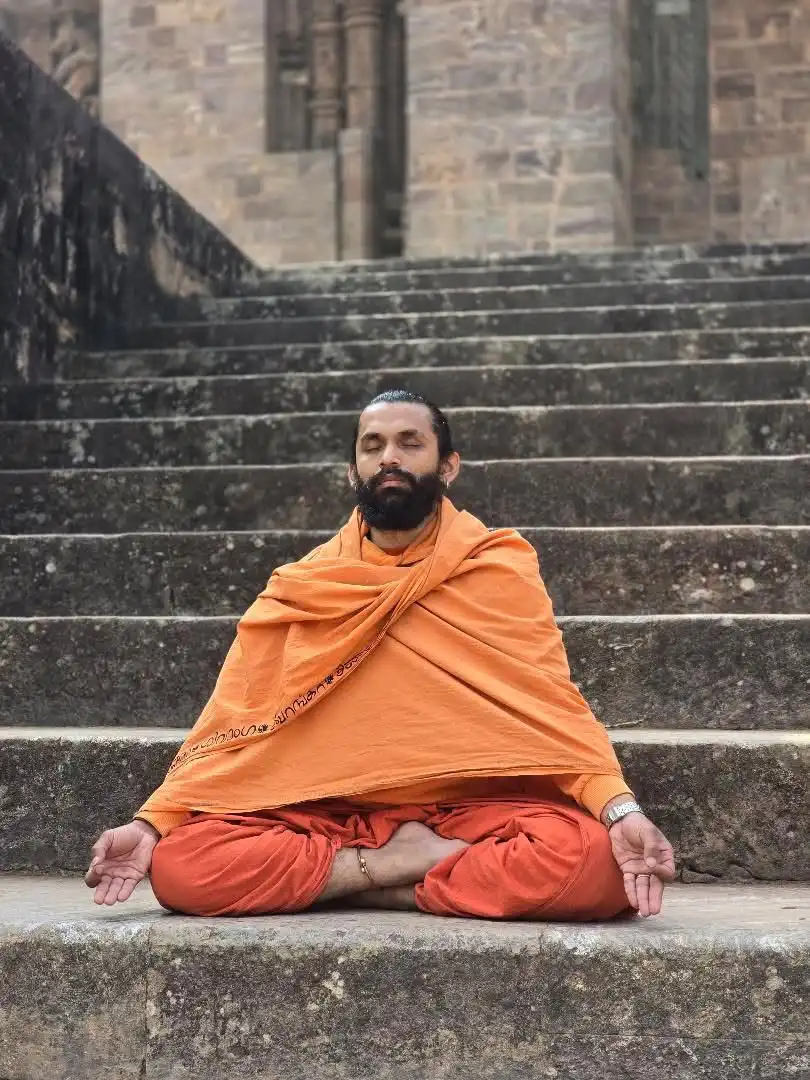

Past the refinery: the threshold of Laya
In the first part of this series we treated Nadi Shodhana as a refinery a machine for stripping prana from raw air, cooking it in the navel fire, and colliding the solar and lunar currents at the brow until the central channel is forced open. That whole apparatus has one purpose, and it is not the perpetual manipulation of air. It is to make the air unnecessary.
In the technical hierarchy of the Nath Sampradaya, the physical breath the Sthula Prana, the gross gaseous current is only the outer scaffolding of the structure. The real building is raised inside it. The ultimate trajectory of Hatha Yoga is not better breathing but the dissolution of breath into Laya: the state of non-dual absorption where the individual mind, and its constant tracking of time, are swallowed into the primordial sound (Nada) and the light of the Supreme Void (Shunya).
This second map picks up exactly where the first left off at the moment the channels are clean and the breath, having done its work, begins to disappear. The opening sections are for beginners who have only ever met alternate-nostril breathing as a calming drill. The middle is for those already steady in retention and the bandhas. The last sections describe the deep machinery the piercing of the knots, the reversal of the throat lock, the convergence of the seals for sadhaks who already taste suspension and want a frame for what is moving inside them.
For beginners: what "Kaivalya Kumbhaka" means
Everything here turns on a transition the texts call Kevala Kumbhaka, which the Naths, pointing at its quality of absolute aloneness, also name Kaivalya Kumbhaka the isolated, pure, unconditioned retention.
In ordinary pranayama, you do the holding. You inhale, decide to retain, count, and release. The Gheranda Samhita, in its fifth chapter on pranayama (around 5.84 onward), calls this Sahita Kumbhaka retention joined to a deliberate in-breath or out-breath, performed with effort. Kevala, or Kaivalya, is its opposite. The breath simply stops. The respiratory muscles fall still not because you clamp them, but because the internal pressure of the body has reached equilibrium with the atmosphere outside it, and the lungs have nothing left to ask for.
A simple way to hold it as a beginner:
- Sahita is you holding the breath.
- Kaivalya is the breath releasing you.
The crucial point, the one the whole of Laya Yoga rests on, is that when the lungs go silent the life-force does not stop. It changes state. It drops out of the gross, gaseous register (Sthula Prana) and into a purely psychic, frictionless circulation the Naths call Pranavritti: the movement of unconditioned prana through the subtle channels, with no air involved at all.
You do not chase this. You prepare the body so it can arrive. Daily Nadi Shodhana, an unhurried diet, deep sleep these are the entire foundation, exactly as in Part I. Skip them and nothing below will do anything but burn.
The lineage: the Nath Sampradaya and the doctrine of Gorakshanath
To understand why the Naths trust this breathless state so completely, you have to understand how they see the body. The Nath Sampradaya is an ancient order of yogic adepts who trace their descent from Adinath (Lord Shiva himself), through Matsyendranath and his great disciple Gorakshanath. Their root insight is that the human being is a Pinda a microcosm that contains, in miniature, the entire Brahmanda, the cosmic egg. Everything the universe is, the body already is.
The Naths also diagnosed the human problem with precision: we live in fragmented consciousness because our life-force is perpetually divided and leaking outward through the sensory gates. The mind cannot be stilled while the prana scatters and the prana scatters as long as the breath runs. In the Nath teaching and the Hatha Yoga Pradipika says the same in its fourth chapter the mind and the breath are mixed like milk and water: when one moves, the other follows; still one and you still the other.
So the Nath technology does not try to calm the wind in the house. It collapses the wind into the central pillar. The Goraksha Samhita counts the same 72,000 nadis we met in Part I, but it adds that the network is anchored and bound by three energetic knots the Granthis which hold our evolutionary, emotional, and intellectual conditioning in place. Working under the lineage mandate of texts like the Siddha-Siddhanta Paddhati, the Nath yogi treats the body as an alchemical vessel, cooking the self (Kaya-Sadhana) until the gross form is refined into a radiant, deathless vehicle a Divya Deha. That cooking cannot happen on the coarse, intermittent friction of gaseous breathing. It needs the steady, unbroken, internal heat of Kumbhaka.
From gaseous breath to Pranavritti
When the suspension of Kaivalya Kumbhaka settles, the physical atmosphere drops away. The air left in the lungs goes inert, but awareness of energy grows hyper-acute. This is the dawn of Pranavritti.
Even with no air crossing the nostrils, the yogi clearly tracks a rhythmic, alternating current rising up the left side (Ida) and descending down the right (Pingala), then reversing. There is no muscle driving it. It moves on Ichha Shakti (the power of will) and Jnana Shakti (the power of knowing) the channel is traced by attention alone, and the prana follows attention.
And without the turbulence of air molecules scraping the nasal passages, the current moves differently. It accelerates. It loses its gaseous quality and becomes something coherent and dense a frictionless stream the Naths describe as Prana-Spanda, the primordial throb of life-force operating in its sovereign, unconditioned state. The movement is smooth, silent, and saturated with a raw intelligence the gross breath never carried.
Lungs absolutely still → attention traces Ida and Pingala → prana follows attention → a frictionless, coherent current the breath without air.
Granthi Bhedana: piercing the three knots
Once the prana runs at this unconditioned frequency, it is no longer spread thin across the superficial paths of the body. It gathers into a single, sharp, laser-like vanguard, and turns to its real work: Granthi Bhedana, the piercing of the three evolutionary bottlenecks. The knots are pierced in order, from the floor of the body upward.
Brahma Granthi the knot of survival and inertia
The first knot sits at the base, around the Muladhara and Svadhisthana centers. It binds consciousness to the material world to survival, physical security, and deep-seated fear, and to the heavy inertia of identifying as nothing but a body. Holding Kaivalya Kumbhaka, the yogi directs the tracked current of Pranavritti down to this base, and the compression of the lower locks applies a sustained heat (Agni) directly to the knot. As the prana pierces Brahma Granthi, physical inertia releases. The conviction of being merely a physical entity loosens, and the floor of the central path is laid open.
Vishnu Granthi the knot of emotion and control
The second knot is woven at the Anahata, the heart. It is made of emotional attachment, the ego's craving for control, personal history, and the deep need for psychological preservation the precise knot that makes a person feel separate from the rest of existence. When the refined current is driven upward from the base, it meets this dense emotional fortress, and piercing it asks for absolute surrender inside the breathlessness. As the current cuts through, the heart center can open with great force often felt as a wave of unconditioned love, or the sudden dissolution of one's personal story. The small domain of the ego is surrendered to the larger flow.
Rudra Granthi the knot of intellect and dissolution
The final bottleneck stands at the Ajna, the brow. It is built of intellectual pride, structural concepts, attachment to psychic visions, and the last boundary of the dividing mind and it is the hardest to break, because it defends itself with the very tools of higher knowledge. As Pranavritti reaches this summit the mind tries to rationalize the experience, but the sheer pressure of the suspension leaves no room for thought. The prana strikes Rudra Granthi like a diamond drill, and when it shatters, the dualistic operation of the brain ceases. The split between inside and outside, observer and observed, simply vanishes.
Brahma Granthi (base, survival) → Vishnu Granthi (heart, ego) → Rudra Granthi (brow, intellect). Once the three are pierced and dissolved, the climb through Sushumna stops being a labored uphill battle. The bottlenecks are gone, and the central channel becomes a frictionless vertical line.
The reversal of Jalandhara Bandha
In the outer stages of pranayama and throughout Part I Jalandhara Bandha, the throat lock, is a downward valve. The chin drops into the jugular notch, compressing the carotid sinuses, slowing the heart, and capping the pressurized air so it cannot shoot up into the brain and cause disorientation. It is a ceiling.
Inside Kaivalya Kumbhaka the Naths invert it. When you are no longer moving gaseous air, there is no air pressure left to threaten the brain, and the lock no longer needs to hold anything down. The chin stays placed exactly as before, but the energetic vector reverses. By a subtle engagement of the deep pharyngeal muscles and a slight lift of the hyoid bone within the locked throat, Jalandhara stops pressing down and begins to draw up. It becomes a hydraulic pump an intense upward vacuum inside the Sushumna column, working like a siphon.
As Samana Vayu cooks the gathered energy at the navel exactly as it did in the refinery this reversed lock grabs the liquidized prana, draws it out of the abdominal furnace, and propels it straight up through the chest, past the heart, into the higher centers. The throat is no longer a closed doorway. It becomes a launchpad.
Gross Jalandhara → a ceiling that pushes energy down to the navel fire. Reversed Jalandhara → a pump that pulls the cooked energy out of the navel and shoots it up the spine.
The tri-bandha convergence: Khechari and Shambhavi
The reversed throat pump is only one of three seals, and on its own it would leak. Its peak comes when it is synchronized with two supreme mudras of the lineage Khechari Mudra and Shambhavi Mudra forming a single tri-bandha geometry that governs the whole nervous system.
As the throat pumps the purified prana upward, the tongue turns back and up, past the soft palate and into the upper nasal cavity: Khechari Mudra. This is not symbolic. It physically seals the palatal gate, closing the circuit so the rising charge cannot leak out of the cranial cavity and ensuring that the Amrita the cooling lunar nectar the Hatha Yoga Pradipika describes raining from the moon at the palate is caught and circulated, rather than falling into the digestive fire below to be burned.
At the same time the eyes lock into Shambhavi Mudra, turned inward and upward toward the Ajna core. Shambhavi acts as a magnet. While the reversed Jalandhara pushes the prana up from below, Shambhavi pulls it from above, drawing the ascending current straight into the third-eye center.
Reversed Jalandhara pushes from below → Khechari seals the gate and loops the circuit → Shambhavi pulls from above. The three together make a self-sustaining loop. The prana freed from the mechanics of air, unblocked by the destroyed granthis is now distributed without a single ripple of resistance through the entire cleared network of 72,000 nadis. The body settles into a profound energetic resonance, every pathway saturated with uniform, high-frequency life-force.
Laya: the dissolution into Sushumna
With nothing left to push against, and no physical breath to track, the mind loses its last handhold its sense of being separate. It dissolves into the central channel and matches the stillness of the body. This is the real meaning of Laya: the individual current dropping back into the ocean of its unconditioned source, entirely empty of breath, yet fully and vividly alive in the awareness of the Self.
When the convergence holds, the structure undergoes one final shift. The dual pathways of Ida and Pingala do not merely fall quiet they are swallowed whole by the mouth of Sushumna. At this point Nadi Shodhana has completed its evolutionary purpose: the channels are cleaned, the furnace is lit, the knots are broken, and the breath has returned to its origin. The upward-surging Udana Vayu takes command of the system, drawing consciousness up out of the lower matrices and anchoring it in the silent, nectar-dripping caverns of the higher brain.
What is metaphor, and what is felt
A word of honesty, because this language runs even hotter than Part I's. "Plasma stream," "diamond drill," "hydraulic siphon" these are a working model, not a claim about physics. No one has measured Pranavritti on an instrument, and the granthis are not anatomical structures a surgeon would find.
What is not metaphor is the experience. The spontaneous arrest of the breath in Kaivalya Kumbhaka is real and unmistakable the moment the lungs stop asking. The sustained heat at the navel is real. The upward draw when the throat lock inverts is real, and specific. The release that comes when an old fear, or an old grief, or an old certainty lets go at base, heart, and brow that is the most real of all, and it does not feel like a metaphor while it is happening. The model is scaffolding. Trust the sensations; they are the data.
Staying grounded: the cost of skipping the foundation
This is the most potent material in the series, and potent practice breaks people who are not ready. Granthi work in particular reaches straight into survival fear, buried grief, and the structures of the intellect; opened too early, without a stable base, it does not liberate, it destabilizes.
A few non-negotiables:
- Earn the suspension first. Kaivalya Kumbhaka must arrive; it cannot be manufactured. A breath clenched into stillness is just strain wearing the costume of Laya. Years of plain Nadi Shodhana come before any of this.
- Do not pry at the knots. The piercing happens to you when the channel is clear, not because you forced your attention against a heart or a brow. Forcing it is how people end up anxious, dissociated, or grandiose.
- A grounding base, clean diet, deep sleep, and a teacher. Higher conductance asks for a stable system, and this stage in particular asks for a living guide. If you finish practice wired, sleepless, or strangely hollow, the foundation is too thin for the current. Step back to the simple breath and let it reset.
A good order for the path
Walking toward this honestly means continuing the same sequence Part I laid out, and not jumping its rungs:
- Establish daily Nadi Shodhana until the breath is long, smooth, and quiet.
- Add short Antar and Bahya Kumbhaka only once the breath is calm and strain-free.
- Learn Mula, Uddiyana, and Jalandhara Bandha inside those short retentions.
- Let retention ripen, by itself, into genuine suspension Kevala / Kaivalya Kumbhaka. Never force it.
- Only inside that suspension, and only under guidance, allow the current to become Pranavritti and let the granthi piercing unfold in its own order, base to brow.
- Introduce the reversed Jalandhara, then the Khechari and Shambhavi convergence, last of all when the channels can hold the charge without scattering it.
Each stage prepares the system for the next. Every step skipped has to be returned to later usually after the body breaks down and asks for it.
An invitation to the science of dissolution
The territory mapped here the breathless suspension, the psychic circulation, the piercing of the three knots, and the convergence of the seals is the deep core of the upcoming Sadhana Yog Immersion. Part I taught how to clean the channel. This is what the clean channel is for.
We are moving past the gaseous world entirely, into the high-definition reality of Laya. We are not learning to breathe better. We are learning to let the breath go and remain.
Looking beyond: the inner sky and the Khechari Bandha
Entry into the deep Sushumna current opens onto a far more secretive set of mechanics. There is a stage past the Khechari Mudra of this post the Khechari Bandha, the activation of the internal lock, the moment the tongue passes fully behind the palate and seals the respiratory throat from within, so the yogi drinks the cosmic fluid directly and the lungs are bypassed altogether.
That belongs to the final chamber of this transmission a chamber where the human form is set down for the form of the cosmic sky. We will open it soon.
A question to leave you with
Tomorrow morning, sit and let the breath grow quiet. At the bottom of an exhalation, in the pause before the next breath insists on arriving is there a moment when nothing is moving and yet you are entirely, unmistakably here? That gap is the doorway. Laya is not somewhere else. It is one layer in, in the silence the breath was covering all along.


