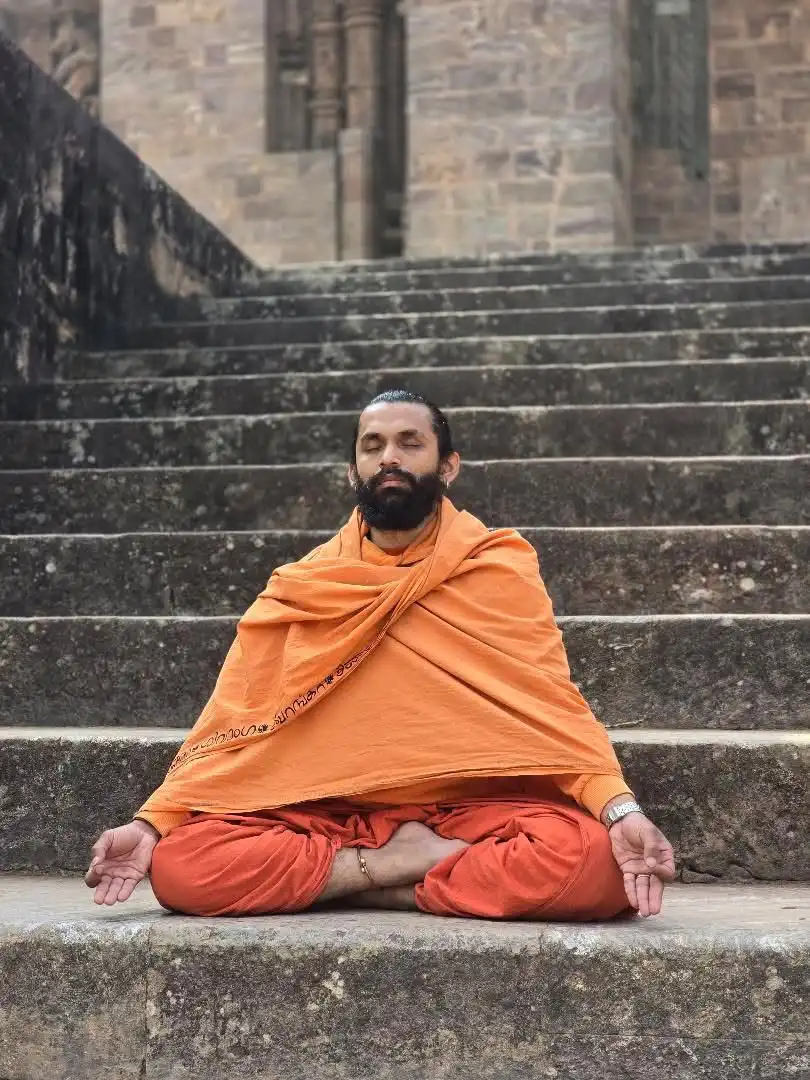

The laboratory of the flesh: Kaya Sadhana and the philosophy of Laya
In the modern global landscape, yoga has been quietly sanitized. Stripped of its raw potency, it has been reduced to aesthetic stretching, muscular conditioning, and a gentle system of stress management. The contemporary seeker is rarely shown the true depth of the work, which is fundamentally alchemical, physiological, and non-dual.
The Nath Sampradaya, the lineage preserved by Adinath, Matsyendranath, and Gorakshanath, left behind a more uncompromising science. The Naths did not treat the body as an obstacle to escape, nor merely as an instrument to be calmed. They recognized the biology itself as an alchemical laboratory, a vessel of Kaya Sadhana (body culture) that has to be re-engineered before it can hold the descent of supreme consciousness.
The ultimate aim of Hatha Yoga is not fitness. It is the collapse of the fragmented, outward-leaking currents of the human system into a single vertical pillar of light: the Sushumna Nadi. That collapse culminates in Laya, the dissolution of the individual mind into the primordial sound (Nada) and the supreme void (Shunya).
This is not an intellectual exercise. It asks for a systematic mastery over the gross physical vectors of the body (Sthula) before one can command the subtle psychic currents (Sukshma). When a practitioner establishes a vacuum through Nauli, masters the visceral mechanics of Vajroli Mudra, and sustains that containment across a long arc of Akhanda Brahmacharya, the nervous system undergoes a genuine metamorphosis. The gross fluids of the body are converted into subtle psychic heat, the breath falls into spontaneous suspension, and the life-force is routed through the central highway of the spine.
This post is the chronicle of that internal engineering, a journey from the dense mechanics of the lower abdomen to the breathless, nectar-dripping chambers of the brain. The first sections are written for beginners who have only ever met yoga as exercise. The middle sections are for those already steady in retention and the bandhas. The final sections describe the deep machinery for sadhaks who already taste suspension and want a frame for what is moving inside them.
A word before we begin, and it matters more here than in any other post in this series. Several of the practices named below, in their classical form, are physically invasive. They were never self-taught. They passed mouth to ear, body to body, under the direct hand of a living teacher who could see when a student was ready and when they were not. Read this as a map of a territory, not as a set of instructions. Nothing here is a how-to. The reasons are spelled out plainly in the grounding section near the end, and they are not negotiable.
For beginners: the whole arc in plain language
Before the mechanics, the shape of the thing.
Every current in an ordinary body leaks outward and downward. We spend our life-force through the senses, through speech, through reproduction, through the endless low-grade friction of an anxious nervous system. The Naths gave the downward, expelling current a name: Apana Vayu, the force responsible for elimination, menstruation, and ejaculation. Apana always pulls toward the floor and out.
The entire path in this post is the reversal of that direction. The body is taught, stage by stage, to turn its currents around: to pull upward what normally falls, to retain what is normally spent, to convert a substance that is normally expelled into a radiance that is stored. A practitioner in whom this reversal has become permanent is called an Urdhvareta, one whose vital current flows strictly upward.
The substance at the center of it all is called Bindu or Virya, the vital essence. The texts treat it not as a mere reproductive fluid but as the most concentrated, refined crystallization of the body's entire life-force. To turn it around and drive it upward, rather than spending it, is to keep the battery of the body charged.
So the arc is simple to state, even if it takes years to walk:
Build the vacuum (Nauli) → reverse the downward gate (Vajroli) → retain and transmute the essence (Bindu Dharana) → ignite it at the navel (Shaktichalan) → route it up the central channel (Sushumna) → catch it in the head (Khechari) → and let the breath itself dissolve (Kaivalya Kumbhaka, Pranavritti).
Everything below is that one sentence, slowed down.
I. The master key: the abdominal vacuum of Nauli
The journey into the deeper chambers begins at the physical core. The Goraksha Samhita asks a blunt question: how can you steady the shifting mind while the wind inside your house is blowing unchecked? To capture that wind, the anatomy must first become a pressurized containment vessel.
Practiced on an advanced scale, Agnisara and Nauli, churning the rectus abdominis many hundreds of times in a single session, fundamentally rewire the deep pelvic and abdominal cavities. This hyper-repetition creates a profound negative-pressure gradient inside the torso, an internal physical funnel.
Consider the pressure dynamics of the trunk. Normally the abdomen is a pressurized box: the diaphragm pushes down on the inhalation and intra-abdominal pressure rises. But when the practitioner performs Nauli after a complete exhalation (Bahir Kumbhaka) and engages a deep Uddiyana Bandha, the diaphragm is drawn high up into the thoracic cavity. This creates a vacuum that drops the internal abdominal pressure far below atmospheric. When the recti are then isolated and churned left to right (Vama Nauli) and right to left (Dakshina Nauli), the vacuum becomes dynamic. It acts as a massive upward-sucking draft, lifting the viscera, massaging the mesenteric beds, and generating an intense internal siphon.
Without this master key, the later stages of Vajroli remain entirely inaccessible. The body must first learn to create an interior space capable of pulling energy upward against the relentless downward drag of gravity. The abdominal funnel is the mechanical furnace where the downward-flowing currents are caught, compressed, and prepared for vertical ascent.
This is the foundation treated at length in The Architecture of the Electric Body: The Nauli Cyclone. If the vacuum is not stable, stop here and build it. Everything downstream depends on it.
II. The ladder of Vajroli: reversing Apana Vayu
Once the abdominal vacuum is reliable, the practitioner steps into Vajroli Mudra, one of the most guarded, secretive, and misunderstood technologies of classical Hatha Yoga. The Hatha Yoga Pradipika devotes its third chapter to it and, tellingly, surrounds it with warnings rather than encouragement.
The aim of Vajroli is not the spectacle that modern accounts fixate on. The aim is a single physiological reversal: to take Apana Vayu, the downward, expelling current, and turn it completely around, so that the urogenital system, which is built to release, learns instead to draw upward and to retain. The practitioner who accomplishes this becomes an Urdhvareta.
In its full classical form, the training begins in the gross physical realm with a graded apparatus and, at the deepest stages, the Urethral Bastika, a fine catheter used to open and desensitize the urethral pathway and to give the practitioner a precise, localized awareness of the deep sphincters and the urogenital diaphragm. This was never an act of mortification. It was a slow anatomical calibration, performed only under a teacher who controlled every variable of hygiene, depth, and readiness.
The classical accounts describe a strict ladder of density. Each rung demands more precise neural control, greater muscular endurance, and a stronger vacuum than the last, drawn entirely from the abdominal funnel of stage one:
- Air. The stage of least resistance. The practitioner establishes the basic neurological pathway and isolates the specific internal contractions required, without tensing the gluteals or thighs.
- Warm water. Weight, volume, and thermal awareness enter. The fluid must be drawn up smoothly, held, and released under complete conscious control.
- Milk. Greater density and fat content ask for a deeper, more coordinated internal grip, refining the sensitivity of the urogenital plexus.
- Liquefied curd. An irregular, textured density that tests the consistency of the suction.
- Oils (sesame or mustard). Viscosity rises sharply. Drawing oil requires sustained, powerful contraction of the deep pelvic floor in absolute coordination with the abdominal vacuum.
- Honey. The peak of physical mastery. Honey is heavy and highly viscous, and drawing it up demands a near-flawless internal vacuum and command over the involuntary muscles of the pelvic floor.
By climbing this scale, the yogi achieves far more than control over the pelvic sphincters. The practice subverts Apana itself. The current that the body has spent its whole life pushing down and out is forced to turn around. The practitioner alters their physiological direction and enters the state of the Urdhvareta, the upward-flowing one.
This is the single stage where I must be most direct: the catheter work is genuinely dangerous outside a qualified living lineage, with real risk of infection and injury, and most serious modern teachers transmit only the non-invasive, energetic form of Vajroli, the conscious sucking and lifting that uses the abdominal vacuum and the pelvic floor alone. The reversal of Apana can be trained that way. Read the classical ladder as the lineage record it is, not as a procedure to attempt.
III. The transmutation of Bindu: from Virya to Ojas
To understand why the reversal matters so much, look closely at the substance being reversed. In the classical texts of Hatha and Ayurveda, Virya or Bindu is not viewed merely as a biological fluid. It is held to be the concentrated, material crystallization of the body's entire life-force.
According to the doctrine of Dhatu Poshana, the food we eat passes through a seven-stage refinement. It becomes Rasa (plasma), then Rakta (blood), then Mamsa (muscle), Meda (fat), Asthi (bone), Majja (marrow), and finally Virya (vital essence). It takes weeks of metabolic labor to distill a single drop of the last tissue from the first. The outward expulsion of Virya, in this view, is a vast expenditure of refined metabolic and spiritual capital.
The Hatha Yoga Pradipika is unambiguous about its value:
"As long as the Bindu is steady in the body, where is the fear of death? As long as the Bindu is retained, the life force remains unbroken."
When a practitioner has mastered Vajroli and maintained an unbroken shield of celibacy over a long arc, a state the Naths call Akhanda Brahmacharya, the entire relationship to this energy changes. The downward gate stays sealed by the Vajroli lock even at the height of stimulation. The essence is not thrown outward. It is drawn forcefully inward and upward.
Retained and driven up consistently over years, the body stops treating this essence as something to expel. It is reabsorbed, broken down and taken back through the lymphatic system and the fine capillaries of the reproductive tract into the bloodstream. This is the literal conversion the texts call the making of Ojas (spiritual radiance) and Tejas (psychic heat). Ojas fuels the higher centers of the brain, fortifies immunity, and is said to create the luminous field, the distinct presence, around an established practitioner. The mind grows stable, the memory sharpens into Medha, and the nervous system gains the insulation it needs to carry high-voltage currents without fraying.
This is Bindu Dharana, the retention of the drop. It is the slow conversion of a spent fluid into a stored fire.
IV. Shaktichalan Kriya: igniting the navel furnace
Where does the retained energy go? With the lower gate sealed by the Vajroli lock and Mula Bandha, a rising volume of kinetic charge has only one direction available: inward and upward. This containment creates a volatile concentration at the base of the spine, in the Muladhara and Svadhisthana centers.
Trapped, that charge interacts with the digestive fire, Jatharagni, in the lower abdomen. When the abdominal vacuum of Nauli and Uddiyana is applied to this pressurized environment, it works like oxygen pumped into a blast furnace. The interaction generates an intense internal heat the Naths call Yogagni. The friction is the stroke of lightning at the base of the mountain, and it triggers the genuine mechanics of Shaktichalan Kriya, the churning and moving of the primordial power.
The dormant Kundalini Shakti, described as a serpent coiled three and a half times around the Swayambhu Linga at the base of the spine, is jolted awake by the pressure and heat. It uncoils and seeks an exit. Because the lower exits are sealed by Vajroli and Mula Bandha, the only path open is the mouth of the central channel, the Sushumna Nadi.
The first undeniable glimpses of unconditioned consciousness arrive in these moments. The energy bursts past the lower centers, sensory processing falls quiet, and the baseline of pure, non-dual awareness is briefly revealed. Over years of continuous Bindu Dharana, this rising current stops being a temporary spike. It becomes a standing circuit, charging the nervous system like an immense, self-sustaining battery. (The relationship of this churning to spontaneous breath retention is mapped in From Physical Breath to Prana-Vritti.)
V. The map of the central channel: Sushumna and its layers
To follow where the energy travels, we need the geography of the subtle nervous system, the Nadi Sansthana. The body holds thousands of channels, but three are paramount.
- Ida Nadi, the left channel, tied to the left nostril, the moon, cooling energy, the parasympathetic tone, and the receptive principle. It governs mental and emotional processing.
- Pingala Nadi, the right channel, tied to the right nostril, the sun, heating energy, the sympathetic tone, and the active principle. It governs action, digestion, and outward expression.
- Sushumna Nadi, the central channel, running through the core of the spinal cord from the perineum to the crown. It is the channel of liberation, operating outside the dualistic swing of Ida and Pingala.
In the ordinary person, Sushumna is dormant, its lower mouth blocked by the unawakened Kundalini. The life-force alternates between Ida and Pingala, and the breath shifts dominance from one nostril to the other roughly every ninety minutes. That endless alternation is what keeps the mind trapped in pairs: good and bad, hot and cold, attraction and aversion.
The central channel is not a single tube. The texts describe concentric layers, each subtler than the last:
- Sushumna, the outermost layer, corresponding to the central canal of the spinal cord.
- Vajrini Nadi, the second layer, full of solar luster.
- Chitrini Nadi, the third, highly subtle, purely sattvic, associated with creative intelligence.
- Brahma Nadi, the innermost core, through which unconditioned consciousness travels to reach the Sahasrara, the thousand-petaled lotus at the crown.
When the heat of Yogagni and the pressure of retained Virya force the current into Sushumna, the breath in the two nostrils reaches equilibrium. The dualistic engine of Ida and Pingala stalls, and the mind stops throwing up erratic thought. The energy rises through the central column not as a vague sensation but as a dense, high-frequency current that clears the subtle pathways of the cord. (For the equilibrium of the two channels and the opening of the center, see The Alchemy of the Split Channel: Kaivalya Kumbhaka.)
VI. The hydrostatic pump: prana, cerebrospinal fluid, and the cranial vault
While the ancient texts speak of Prana, Nadis, and Bindu, the process has a close physical counterpart in the circulation of cerebrospinal fluid (CSF). This is the bridge between the subtle account and the gross body, and it deserves care, so read the honesty note that follows this section before taking any of it as settled fact.
CSF is a clear fluid produced in the ventricles of the brain by the choroid plexus. It flows through the ventricular system, into the subarachnoid space, and circulates down around the cord and up around the brain. It cushions the brain, carries off metabolic waste, and maintains the chemical environment of the central nervous system.
In an ordinary person the flow is passive, driven by the pulse of the cardiovascular system and by respiration. On the inhalation the sacrum flexes slightly; on the exhalation it extends. This subtle movement, the craniosacral rhythm, acts as a gentle pump moving CSF up and down the spine.
When an advanced yogi engages the abdominal funnel of Nauli, applies Mula Bandha, and holds intensive Kumbhaka, they amplify this pump dramatically. During a deep exhalation followed by an intense Uddiyana and Nauli, intra-thoracic and intra-abdominal pressures drop sharply, drawing fluid upward. Then, as the retention is held and the lower locks squeeze, a hydrostatic pressure wave builds at the base of the spine. That wave drives CSF upward through the subarachnoid space into the ventricles. In the language of the tradition, the fluid is pumped up the Sushumna channel.
As CSF is forced into the third and fourth ventricles under pressure, it exerts mechanical and chemical influence on the pineal and pituitary glands. The pineal, which carries calcified micro-crystals, may be piezoelectrically stimulated by this pressure, triggering a neurochemical cascade and the production of endogenous tryptamines and melatonin derivatives. The brainwave signature shifts, dropping from beta and alpha down into deep theta, delta, and even gamma, so the practitioner can remain fully conscious while the body enters a state of deep, regenerative hibernation. In this model, the physical pumping of CSF is the mechanism that translates the subtle current of Kundalini into the gross neurochemical reality of the awakened state.
VII. Khechari Mudra: sealing the cranial circuit
To catch the rising current and the secretions it generates in the head, the practitioner employs Khechari Mudra, the king of mudras. The word means "she who flies through the sky of consciousness." It is the practice of turning the tongue back and up, past the soft palate, into the upper nasal cavity.
The full expression is reached in distinct anatomical stages:
- Stage 1, the freeing of the frenulum. In most people the small fold of membrane under the tongue (the lingual frenulum) restricts its backward travel. In the classical path this is lengthened gradually over months and years through gentle, patient stretching, and in the old method through minute, systematic incisions with a sterile instrument (Chedana), followed by application of turmeric and rock salt. The incision method belongs to the guarded, teacher-supervised tradition; the gradual, non-cutting milking of the tongue is the method serious teachers favor now, and it should be the only method any reader considers.
- Stage 2, passing the soft palate. The tongue is trained to slide back along the roof of the mouth until it slips behind the uvula into the nasopharynx.
- Stage 3, navigating the nasopharynx. Once inside, the tip moves up toward the pharyngeal tonsils and the sphenoid sinus, touching the roof of the nasal pharynx, which lies directly beneath the sella turcica, the bony seat of the pituitary.
Locked into the upper nasal cavity, the tongue serves two purposes, one electrical and one chemical.
The electrical circuit. The body is an electromagnetic field. Treated as a circuit, the tongue acts as one pole and the roof of the nasal cavity as the other. Turning the tongue back and up physically closes the cranial loop, preventing the ascending Prana from leaking out through the mouth or nose and looping the current back down through the front of the body, a closed microcurrent.
The chemical catchment, the nectar of Amrita. The sphenoid sinus and the membranes deep in the nasopharynx are rich in nerve endings connected to the cranial nerves and the hypothalamus. When the tongue presses these points in deep meditation, it is said to stimulate the downward flow of Amrita, the lunar nectar. In the texts the Bindu drips from the moon center in the head and is normally consumed by the sun center at the navel, which is the cause of aging and death. By locking the tongue in Khechari, the yogi catches this nectar before it falls into the abdominal fire, absorbing it directly, cooling the system, slowing the metabolism toward stillness, and gaining a striking independence from hunger, thirst, and decay. (Khechari as the seal on a pressurized rising current is also treated in The Nauli Cyclone; begin with Nabho Mudra, the tongue simply lifted to the soft palate, until the tongue is genuinely ready.)
VIII. The horizon of Laya: Kaivalya Kumbhaka and pure Pranavritti
The long distillation of energy, joined to the pumping of CSF and the cranial seal of Khechari, is the engine that drives the higher experiences of the lineage. The reservoir of Ojas has cleared the central nervous system, and the practitioner transitions from the forceful mechanics of Hatha into the silent domain of Laya Yoga.
Here Kaivalya Kumbhaka descends on its own. Kaivalya is not a forced, aggressive holding of the breath against the urge to inhale. It is an absolute, isolated suspension in which the respiratory muscles fall still because the internal pressure of the body has reached perfect equilibrium with the atmosphere outside it. The lungs go silent. The chest stops moving. The pull of the air drops away.
And yet life does not cease. It shifts entirely into Pranavritti, the purely psychic, frictionless circulation of unconditioned Prana through the central channel. Without the turbulence of air scraping the nasal linings, the current becomes coherent and dense, a stream moving at an accelerated frequency. Driven by intense mental tracking and unyielding will, the yogi feels a liquid current of heat and light trace up the left channel and down the right before collapsing into the central column. This is Prana-Spanda, the primordial throb of life operating independent of gaseous breathing. The body becomes still, cool to the touch at the periphery, while the spine remains an incandescent column of heat.
This is the same threshold mapped in detail in The Alchemy of the Split Channel: Kaivalya Kumbhaka. The difference here is what has been built beneath it: not only a clean channel, but a charged one, fed by years of retained and transmuted essence.
IX. Granthi Bhedana: piercing the cosmic knots
With Prana operating at this breathless frequency inside Kaivalya Kumbhaka, it acts as a laser-sharp vanguard whose work is Granthi Bhedana, the piercing of the three structural knots of human limitation. They are pierced in order, from the floor of the body upward.
- Brahma Granthi, at the Muladhara base. The knot of physical inertia, material binding, survival fear, and identification with the gross body. As the current of Pranavritti strikes the base under the heat of the abdominal vacuum and the upward pull of Vajroli, the conviction of being merely a physical body is broken, and the evolutionary fear of death loosens its grip.
- Vishnu Granthi, at the Anahata heart. The knot of emotional ego, personal history, preference, and the craving for psychological preservation. Piercing it asks for surrender inside the stillness of breathlessness. As the energy blasts through the heart, the separate self dissolves into the universal current, and an unconditioned compassion appears that does not depend on any personal relationship.
- Rudra Granthi, at the Ajna center. The final, stubborn bottleneck of intellectual pride, mental concept, and dualistic tracking. When Pranavritti collides with it under the pressure of the pumped CSF and the seal of Khechari, the distinction between inside and outside, observer and observed, vanishes. The intellect is consumed by direct intuition, and the mind dissolves into the open sky of pure consciousness.
A fuller treatment of the three knots, with the cautions that belong to them, is in the Kaivalya Kumbhaka post; what is added here is only the source of the pressure that pierces them, the charged base built by Vajroli and Bindu Dharana.
X. The inverted lock: the tri-bandha geometry
To sustain this high-frequency current through the cleared channel without harming the delicate tissue of the brain, the Naths restructure the classical locks. In the gross, foundational stages, Jalandhara Bandha, the throat lock, is achieved by pressing the chin toward the chest to cap the upward escape of air and to keep pressure from building in the ears and eyes. It is a downward ceiling.
Inside the breathless laboratory of Kaivalya Kumbhaka its vector inverts. Because there is no longer any air pressure threatening the brain, the throat lock shifts from a defensive barrier into a dynamic, upward hydraulic pump, a Reversed Jalandhara. By adjusting the deep pharyngeal muscles and the hyoid apparatus, the throat creates a vacuum inside the lower chambers of the Sushumna column. That vacuum acts as a siphon, drawing the ascending energy out of the navel furnace and propelling it toward the crown.
This upward drive is integrated into the supreme tri-bandha geometry of the Siddhas:
- Shambhavi Mudra. The gaze is locked inward and upward at the brow center (Bhrumadhya). This internal focus acts as a magnet, pulling the ascending current from above.
- Khechari Mudra. The tongue stays turned back into the upper nasal cavity, closing the cranial circuit, sealing the upper gate, catching the cooling Amrita, and looping the energy through the system.
- Reversed Jalandhara. The throat pump keeps driving the liquefied life-force and the pressurized CSF upward from below, holding the central channel open and unobstructed.
Reversed Jalandhara pushes from below → Khechari seals the gate and loops the circuit → Shambhavi pulls from above. The three together form a self-sustaining loop, distributing the freed Prana through the cleared network without a ripple of resistance.
What is metaphor, and what is felt
A note of honesty, because the language in this post runs hotter than anywhere else in the series. "Plasma stream," "blast furnace," "piezoelectric pineal," "hydrostatic pump": these are a working model, not a settled claim about physiology. No instrument has measured Pranavritti. The granthis are not structures a surgeon would find. The CSF account is a plausible bridge between the subtle and the gross, offered the way the rest of this series offers its physiology, as scaffolding for understanding, not as proven mechanism. Treat the neurochemical specifics as illustration, not as established fact.
What is not metaphor is the experience. The spontaneous arrest of the breath in Kaivalya Kumbhaka is real and unmistakable, the moment the lungs stop asking. The sustained heat at the navel is real. The upward draw when the throat lock inverts is real and specific. The reversal of Apana, the change in the whole tenor of the body once the essence is retained rather than spent, the release when an old fear or grief or certainty lets go at base, heart, and brow: those are the most real of all, and they do not feel like metaphors while they are happening. Trust the sensations. They are the data. Hold the model lightly.
Staying grounded: the cost of skipping the foundation
This is the most potent material in the series, and potent practice breaks people who are not ready. Some of it, attempted alone, does not merely fail to help; it injures. Read these as non-negotiable.
- The invasive practices are not for self-experiment, ever. The urethral stage of Vajroli and the cutting method of Khechari carry real risk of infection and permanent injury, and they belong only inside a qualified living lineage that controls hygiene and readiness. If you are drawn to Vajroli, learn the non-invasive, energetic form. If you are drawn to Khechari, use only the gradual, non-cutting milking of the tongue, or stay with Nabho Mudra. Nothing in this post is an instruction to insert, to cut, or to draw fluid.
- Earn the suspension first. Kaivalya Kumbhaka must arrive; it cannot be manufactured. A breath clenched into stillness is strain wearing the costume of Laya. Years of plain Nadi Shodhana come before any of this.
- Build the base before you charge it. Bindu Dharana and Shaktichalan raise a great deal of energy from the pelvis. Without a daily asana foundation, hip openers, grounding poses, long holds for the legs and pelvis, the Kanda will not safely give up its charge, and what rises will scatter into agitation rather than rising clean.
- Do not pry at the knots. Granthi work reaches straight into survival fear, buried grief, and the structures of the intellect. The piercing happens to you when the channel is clear and charged, not because you forced attention against a heart or a brow. Forced, it destabilizes rather than liberates.
- Clean diet, deep sleep, a living teacher. Higher conductance needs a stable system, and this stage in particular needs a guide who can see you. If you finish practice wired, sleepless, hollow, or grandiose, the foundation is too thin for the current. Step back to the simple breath and let it reset.
A good order for the path
Walking toward this honestly means continuing the same sequence the earlier posts laid out, and not jumping the rungs:
- Establish daily Ujjayi and Nadi Shodhana until the breath is long, smooth, and quiet.
- Build a stable Uddiyana Bandha, then Madhyama Nauli, then the full Nauli churn, until the abdominal vacuum is effortless.
- Add short Antar and Bahya Kumbhaka, and learn Mula, Uddiyana, and Jalandhara Bandha inside them.
- Train the reversal of Apana through the non-invasive form of Vajroli, under guidance, never the invasive ladder.
- Let Brahmacharya and Bindu Dharana mature naturally alongside a strong grounding practice, so retention builds Ojas instead of agitation.
- Allow retention to ripen, by itself, into genuine Kaivalya Kumbhaka. Never force it.
- Only inside that suspension, and only under guidance, allow the current to become Pranavritti, and let Shaktichalan and the granthi piercing unfold in their own order, base to brow.
- Introduce the Reversed Jalandhara, then the Khechari and Shambhavi convergence, last of all, when the channel can hold the charge without scattering it. Begin Khechari with Nabho Mudra.
Each stage prepares the system for the next. Every step skipped has to be returned to later, usually after the body breaks down and asks for it.
An invitation to the science of the Sovereign Void
The territory mapped here, the vacuum of Nauli, the reversal of Apana, the transmutation of Bindu into Ojas, the pumping of the central channel, and the breathless heights of Kaivalya Kumbhaka and Pranavritti, is the deep core of the upcoming Sadhana Yog Immersion. The earlier posts taught how to clean the channel and how to light it. This is what the clean, charged channel is finally for.
We are not learning to be flexible. We are not even learning to breathe better. We are learning to re-engineer the human vessel so that it can hold the descent of supreme consciousness, and then to set the breath down and remain.
A question to leave you with
Tomorrow morning, sit and let the breath grow quiet. At the bottom of an exhalation, in the pause before the next breath insists on arriving, is there a moment when nothing is moving and yet you are entirely, unmistakably here? That gap is the doorway. The whole architecture in this post, the vacuum, the reversal, the rising fire, the sealed crown, is only there to widen that single gap until you can live inside it. The sovereign void is not somewhere else. It is one layer in, in the silence the breath was covering all along.


